


Hey there! As a supplier of server cooling impellers, I often get asked about the maximum rotational speed of these little powerhouses. So, let's dive right in and explore this topic.
First off, what's a server cooling impeller? Well, it's a crucial part of the cooling system in servers. Servers generate a ton of heat when they're running, and if that heat isn't managed properly, it can lead to all sorts of problems, like hardware failures and reduced performance. That's where the cooling impeller comes in. It spins around, sucking in cool air and blowing it over the hot components, helping to keep everything at a safe temperature.
Now, let's talk about the maximum rotational speed. The maximum rotational speed of a server cooling impeller can vary quite a bit depending on several factors. One of the main factors is the design of the impeller itself. Different impeller designs have different aerodynamic properties, which can affect how fast they can spin efficiently. For example, an impeller with a more streamlined design might be able to spin faster than one with a bulkier design.
Another important factor is the size of the impeller. Generally speaking, smaller impellers can spin faster than larger ones. This is because smaller impellers have less mass, so they require less energy to accelerate and decelerate. However, smaller impellers also have a lower airflow capacity, so they might not be suitable for cooling larger servers or servers that generate a lot of heat.

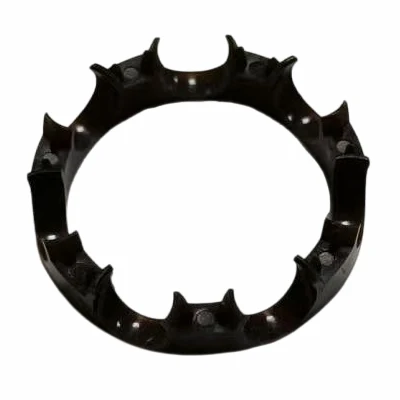
The type of motor used to drive the impeller also plays a big role. High - performance motors can provide more power and torque, allowing the impeller to reach higher rotational speeds. Some motors are designed specifically for high - speed applications, with features like low - friction bearings and efficient windings.
The environment in which the server operates is also a consideration. If the server is in a hot or dusty environment, the impeller might not be able to spin at its maximum speed for long periods of time. Dust can clog the impeller blades, reducing its efficiency and increasing the risk of overheating. High temperatures can also cause the motor to overheat, which can limit the impeller's speed.
In general, the maximum rotational speed of server cooling impellers can range from a few thousand revolutions per minute (RPM) to tens of thousands of RPM. For small, low - power servers, impellers might have a maximum speed of around 3,000 - 5,000 RPM. These impellers are usually used in applications where noise is a concern, as higher speeds tend to generate more noise.
On the other hand, for high - performance servers that need to dissipate a large amount of heat, impellers can have maximum speeds of 10,000 RPM or more. These high - speed impellers are often used in data centers or servers that are running resource - intensive applications, like artificial intelligence or cryptocurrency mining.
But here's the thing: just because an impeller can spin at a high speed doesn't mean it should always be running at that speed. Running an impeller at its maximum speed all the time can put a lot of stress on the motor and the impeller itself, which can lead to premature wear and tear. It can also generate a lot of noise, which can be a problem in some environments.
That's why many server cooling systems are designed to adjust the impeller speed based on the temperature of the server. When the server is running at a normal temperature, the impeller can spin at a lower speed, reducing noise and energy consumption. But when the temperature starts to rise, the impeller speed can be increased to provide more cooling.
At our company, we offer a wide range of server cooling impellers to meet different needs. Whether you need a small, quiet impeller for a home server or a high - speed impeller for a large data center, we've got you covered. And we're not just limited to server cooling impellers. We also offer other related products, like the Notebook Mini Cooling Impeller, which is perfect for keeping laptops cool, the Plastic Deep Groove Ball Bearing Cage, an important component for smooth operation, and the VR Glasses Mini Cooling Impeller, designed to prevent overheating in VR devices.
If you're in the market for server cooling impellers or any of our other products, we'd love to hear from you. We can work with you to find the right solution for your specific requirements. Whether you're a small business owner looking to cool a few servers or a large enterprise managing a massive data center, we have the expertise and the products to help you keep your equipment running cool and efficiently. So, don't hesitate to reach out and start a conversation about your cooling needs.
References:
- Engineering textbooks on fluid dynamics and heat transfer
- Industry reports on server cooling technologies




