Hey there! As a supplier of Busbar U V W, I often get asked about the magnetic field generated by these busbars. So, I thought I'd take some time to break it down and explain what's going on.
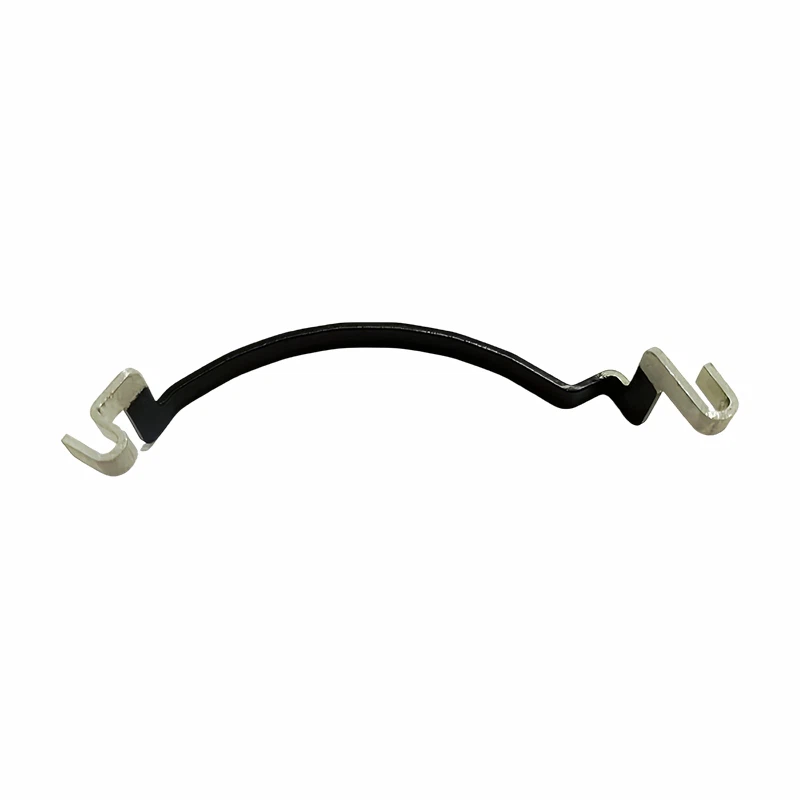
First off, let's talk a bit about what Busbar U V W are. Busbar U V W are essential components in electrical systems, especially in three - phase power applications. They are used to distribute electrical power from a source to various loads. Each phase (U, V, and W) has its own busbar, and they carry alternating currents that are out of phase with each other by 120 degrees.
Now, when an electric current flows through a conductor, it creates a magnetic field around it. This is a fundamental principle of electromagnetism, discovered by Hans Christian Ørsted in the early 19th century. The magnetic field is a vector quantity, which means it has both magnitude and direction.
The magnetic field generated by a single straight conductor can be calculated using Ampere's law. For a long, straight conductor carrying a current (I), the magnetic field (B) at a distance (r) from the conductor is given by the formula (B=\frac{\mu_0I}{2\pi r}), where (\mu_0 = 4\pi\times10^{- 7}\ T\cdot m/A) is the permeability of free space.
In the case of Busbar U V W, things get a bit more complicated because we have three conductors carrying currents that are out of phase. The magnetic fields generated by each busbar interact with each other. The overall magnetic field in the vicinity of the Busbar U V W is the vector sum of the magnetic fields produced by each individual busbar.
Let's assume that the currents in the U, V, and W busbars are (I_U = I_m\sin(\omega t)), (I_V=I_m\sin(\omega t - 120^{\circ})), and (I_W = I_m\sin(\omega t + 120^{\circ})) respectively, where (I_m) is the maximum current and (\omega) is the angular frequency of the alternating current.
To find the total magnetic field at a particular point in space near the busbars, we need to calculate the magnetic field due to each busbar at that point using the formula for a straight conductor and then add them vectorially.
The direction of the magnetic field around a conductor can be determined using the right - hand rule. If you grasp the conductor with your right hand such that your thumb points in the direction of the current, then your fingers curl in the direction of the magnetic field.
The interaction of the magnetic fields from the three busbars can have some interesting effects. For example, in some cases, the magnetic fields can cancel each other out in certain regions, while in other regions, they can add up to create a stronger magnetic field.
One of the practical implications of the magnetic field generated by Busbar U V W is electromagnetic interference (EMI). The magnetic fields can induce unwanted currents in nearby conductors, such as cables or electronic components. This can lead to malfunctions in sensitive electronic equipment. To mitigate EMI, proper shielding and grounding techniques are often employed.
Another aspect to consider is the mechanical forces between the busbars. The magnetic fields from the different busbars can exert forces on each other. These forces are known as Ampere forces. The magnitude of the force per unit length between two parallel conductors carrying currents (I_1) and (I_2) separated by a distance (d) is given by (F=\frac{\mu_0I_1I_2}{2\pi d}).
In a three - phase system with Busbar U V W, the forces between the busbars can vary depending on the phase relationship of the currents. During normal operation, the forces are relatively stable, but during fault conditions, such as short - circuits, the currents can increase significantly, leading to large mechanical forces that can potentially damage the busbars.
Now, let's talk about some of the products related to Busbar U V W that we offer. We also supply Pillow Cover and Fisheye Terminals. Pillow covers are used to protect the busbars and provide insulation, while fisheye terminals are used for making reliable electrical connections.
If you're in the market for high - quality Busbar U V W, pillow covers, or fisheye terminals, we've got you covered. Our products are made with the highest quality materials and are designed to meet the strictest industry standards. Whether you're working on a small electrical project or a large - scale industrial application, we can provide the right solutions for your needs.

If you're interested in learning more about our products or have any questions about the magnetic field generated by Busbar U V W, don't hesitate to reach out. We're here to help you make the best choices for your electrical systems. Contact us today to start a procurement discussion and find out how we can meet your requirements.
References
- Halliday, D., Resnick, R., & Walker, J. (2014). Fundamentals of Physics. Wiley.
- Grob, B. (2007). Basic Electronics. McGraw - Hill.