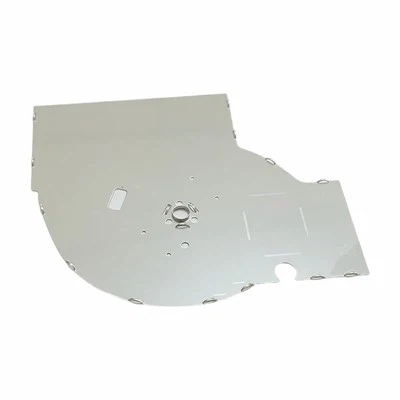
Hey there! As a supplier of GPU cooling impellers, I often get asked about the differences between centrifugal and axial GPU cooling impellers. So, I thought I'd write this blog post to break it down for you in a simple and easy-to-understand way.
Let's start with the basics. A GPU cooling impeller is a crucial component in keeping your graphics processing unit (GPU) cool. When your GPU is working hard, like when you're gaming or doing some heavy video editing, it generates a lot of heat. If this heat isn't dissipated properly, it can lead to performance issues and even damage to the GPU. That's where the cooling impeller comes in.
Axial GPU Cooling Impellers
Axial impellers are the more common type you'll see in many consumer-grade GPUs. They work kind of like a fan you'd have in your room. The blades of an axial impeller are designed to move air in a straight line, parallel to the axis of the impeller's rotation.
One of the biggest advantages of axial impellers is their high airflow rate. They can move a large volume of air quickly, which is great for general cooling purposes. If you're just using your GPU for normal gaming or everyday tasks, an axial impeller can usually do the job just fine.
Another plus is that axial impellers are generally quieter compared to centrifugal ones. This is because the design allows for a more smooth and efficient airflow, which reduces the amount of noise generated. So, if you're someone who doesn't like a lot of noise while you're using your computer, an axial impeller might be the way to go.
However, axial impellers do have their limitations. They're not as effective at generating high pressure as centrifugal impellers. This means that if you have a GPU with a more complex cooling system, like one with a lot of heat pipes or a thick heatsink, an axial impeller might struggle to push the air through all those obstacles.
Centrifugal GPU Cooling Impellers
Centrifugal impellers, on the other hand, work a bit differently. Instead of moving air in a straight line, they move air radially, or outwards from the center of the impeller. The blades of a centrifugal impeller are curved, which helps to create a swirling motion that forces the air outwards.
The main advantage of centrifugal impellers is their ability to generate high pressure. This makes them ideal for GPUs with more complex cooling systems. They can easily push air through tight spaces and around obstacles, ensuring that all parts of the GPU are getting enough cooling.
Centrifugal impellers are also more efficient at handling static pressure. Static pressure is the resistance that the air encounters as it moves through the cooling system. With a centrifugal impeller, you can be sure that the air will reach all the nooks and crannies of your GPU's cooling setup.
But, like axial impellers, centrifugal impellers also have some drawbacks. They tend to be noisier, especially at high speeds. The swirling motion of the air can create more turbulence, which in turn generates more noise. And, they usually have a lower airflow rate compared to axial impellers. So, if you need a large volume of air to be moved quickly, a centrifugal impeller might not be the best choice.
Which One Should You Choose?
So, now that you know the differences between centrifugal and axial GPU cooling impellers, which one should you choose? Well, it really depends on your specific needs.
If you have a basic GPU setup and you're mainly using it for casual gaming or everyday tasks, an axial impeller is probably sufficient. It'll keep your GPU cool, and it won't make too much noise.
On the other hand, if you have a high-end GPU with a complex cooling system, or if you're into overclocking and need maximum cooling performance, a centrifugal impeller might be a better option. It can handle the high pressure requirements of your system and ensure that your GPU stays cool even under heavy loads.
As a GPU cooling impeller supplier, we offer a wide range of both axial and centrifugal impellers to meet your needs. Whether you're a PC builder looking for the perfect cooling solution for your custom rig, or a gamer who wants to upgrade their existing GPU cooler, we've got you covered.
By the way, if you're also interested in other related products, we have some great options. Check out our Plastic Needle Roller Bearing Cage, Server Cooling Impeller, and Plastic Deep Groove Ball Bearing Cage.


If you're interested in purchasing our GPU cooling impellers or have any questions about which type is right for you, don't hesitate to get in touch. We're always happy to help you find the best cooling solution for your GPU. Just reach out to us, and we'll start the conversation about how we can meet your needs.
References
- Cooling Technology Institute. (2023). Fundamentals of Cooling Equipment.
- Thermal Engineering Handbook. (2022). GPU Cooling Systems.