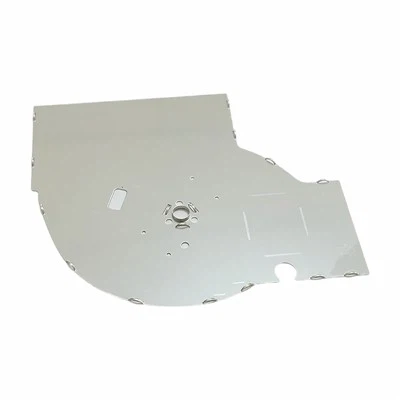
Hey there! As a supplier of Server Cooling Impellers, I often get asked how to determine the appropriate impeller diameter for a server cooling system. It's a crucial question because getting the diameter right can significantly impact the efficiency and effectiveness of the cooling system. In this blog, I'll share some insights on this topic based on my experience in the industry.
Understanding the Basics of Server Cooling
Before we dive into determining the impeller diameter, let's quickly go over how server cooling systems work. Servers generate a lot of heat due to the continuous operation of their components, such as CPUs, GPUs, and memory modules. If this heat isn't properly managed, it can lead to reduced performance, hardware failures, and even data loss. That's where cooling systems come in.
A typical server cooling system consists of fans, heat sinks, and sometimes liquid cooling components. The impeller is a key part of the fan. When it rotates, it draws in air and pushes it through the system, carrying away the heat. The diameter of the impeller plays a big role in how much air it can move and how efficiently it can do so.
Factors Affecting the Choice of Impeller Diameter
Server Size and Configuration
The physical size of the server is one of the first things to consider. Larger servers usually have more space for bigger impellers. If you have a large rack-mounted server with a lot of internal volume, you can potentially use a larger impeller. This allows for more air to be moved through the system, which is great for cooling multiple components or high-power ones.
On the other hand, if you're dealing with a smaller server, like a blade server, space is limited. In this case, you'll need to choose a smaller diameter impeller that can fit within the available space without obstructing other components. You can find a variety of Server Cooling Impeller options on our website to suit different server sizes.
Heat Load
The amount of heat generated by the server's components is another crucial factor. High-performance servers with powerful CPUs and GPUs produce a lot of heat. To effectively cool these components, you'll need an impeller that can move a large volume of air. Generally, a larger diameter impeller can move more air than a smaller one, so it's better suited for servers with high heat loads.


To calculate the heat load, you need to consider the power consumption of each component in the server. The higher the power consumption, the more heat is generated. Once you have an estimate of the heat load, you can start to narrow down the appropriate impeller diameter.
Airflow Requirements
The airflow requirements of the server cooling system depend on how the server is designed and how it operates. Some servers require a high-pressure airflow to move air through narrow channels or over complex heat sink designs. In this case, a smaller diameter impeller with a higher rotational speed might be more suitable, as it can generate the necessary pressure.
Other servers may need a large volume of low-pressure airflow. For these applications, a larger diameter impeller can provide the required airflow at a lower rotational speed, which can be quieter and more energy-efficient.
Calculating the Appropriate Impeller Diameter
Calculating the exact impeller diameter can be a bit complex, but there are some general guidelines you can follow. First, you need to determine the required airflow rate in cubic feet per minute (CFM). This can be estimated based on the heat load of the server and the cooling efficiency of the system.
Once you have the required airflow rate, you can use the following formula as a starting point:
[CFM = A \times V]
where (CFM) is the airflow rate, (A) is the cross - sectional area of the impeller (which is related to the diameter), and (V) is the air velocity.
The cross - sectional area of a circular impeller is given by (A=\pi\times(\frac{D}{2})^2), where (D) is the diameter of the impeller.
By rearranging the formula, you can get an idea of the impeller diameter required to achieve the desired airflow rate. However, keep in mind that this is a simplified calculation, and other factors such as the impeller blade design, the motor's power, and the system's resistance also need to be considered.
Importance of Testing and Validation
Even after calculating the appropriate impeller diameter, it's important to test and validate the design in a real - world environment. You can build a prototype of the server cooling system with the selected impeller and measure the actual airflow, pressure, and temperature. This will help you determine if the impeller is performing as expected and if any adjustments are needed.
During testing, you can also check for any noise issues. A larger impeller may operate at a lower rotational speed, which can result in less noise. However, if the impeller is too large for the system, it may cause turbulence and increase the noise level.
Other Considerations
In addition to the factors mentioned above, there are a few other things to keep in mind when choosing the impeller diameter.
Compatibility with Other Components
The impeller needs to be compatible with the other components of the cooling system, such as the motor and the housing. The motor should have enough power to drive the impeller at the required speed, and the housing should be designed to accommodate the impeller diameter without causing any airflow restrictions.
Cost
The cost of the impeller is also an important factor. Generally, larger impellers may be more expensive than smaller ones. However, you need to balance the cost with the performance and efficiency of the cooling system. Investing in a higher - quality impeller with the right diameter can save you money in the long run by reducing energy consumption and preventing hardware failures.
Conclusion
Determining the appropriate impeller diameter for a server cooling system is a complex process that involves considering multiple factors such as server size, heat load, airflow requirements, and compatibility with other components. By understanding these factors and following the guidelines mentioned in this blog, you can make an informed decision and choose the right impeller for your server cooling needs.
At our company, we offer a wide range of Server Cooling Impeller and Computer CPU Cooling Impeller options to meet different requirements. We also provide high - quality Plastic Needle Roller Bearing Cage products. If you're interested in learning more about our products or have any questions about choosing the right impeller diameter, feel free to contact us for a detailed discussion and potential purchase. We're here to help you find the best solutions for your server cooling systems.
References
- Cooling Techniques for Data Centers, Industry Whitepaper.
- Handbook of Thermal Management in Electronic Systems.